

Flight Data Monitoring has always excelled at answering what happened. But for safety teams and flight crews trying to understand why it happened — and more importantly, what it felt like in the moment — data plots and parameter traces have always left something to be desired.
(If you’re new to Flight Data Monitoring, be sure to check out our complete guide to Flight Data Monitoring to learn more about what it is, how to get started, and how to have an effective program.)
That gap became sharply clear during a recent TCAS event review with one of our government aviation customers. The crew had responded correctly and decisively, but the debrief raised a familiar challenge: how do you recreate the full situational picture of a multi-aircraft encounter using only the recorded data from one of the aircraft?
Bringing the Intruder Aircraft Into the Room
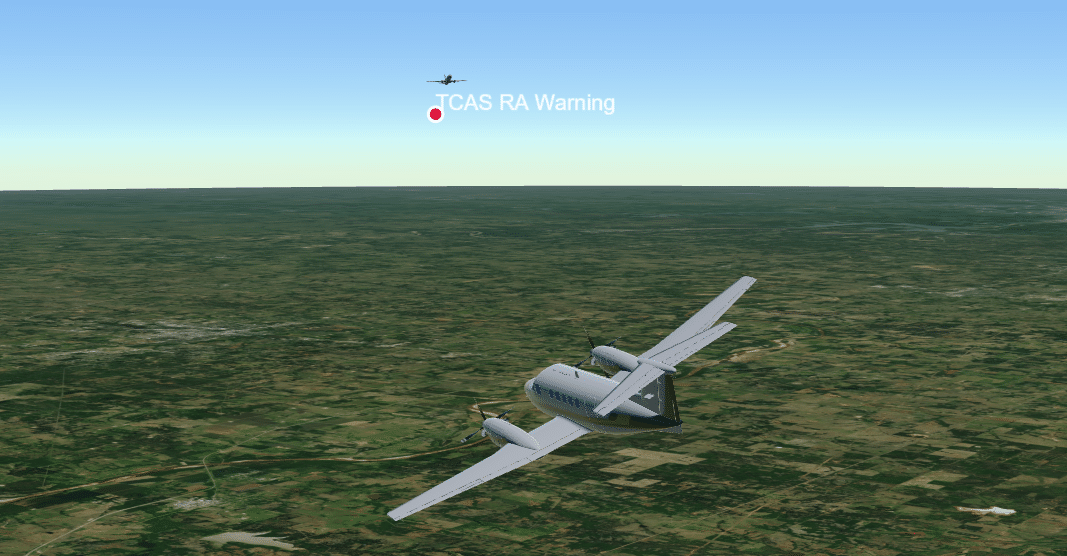
We recently introduced the ability to supplement a customer’s recorded flight data with ADS-B position data from other aircraft in the vicinity — sourced from providers like FlightAware or Flightradar24. The result is a complete, synchronized 3D animation of an encounter as it actually unfolded: both aircraft, both trajectories, full geometric context.
For this particular TCAS event, that meant the crew and safety team could watch the encounter replay with the intruder aircraft visible in real time, not inferred from TCAS advisories, but tracked and rendered from actual position data.
The feedback from the customer’s safety team said it better than we could:
“The addition of the intruder aircraft in the replay provided a level of situational understanding that we simply have not had before with traditional FOQA/FDM event reviews.”

Screenshot from Sky Analyst FDM showing the Primary aircraft immediately before the TCAS warning.
What Changes When You Can See Both Sides
The most significant shift was the ability to view the event from multiple perspectives — including from the intruder aircraft’s vantage point. That capability changed the nature of the review entirely.
Rather than analyzing flight parameters and reconstructing geometry mentally, the crew could watch the closure rate develop, observe the intruder’s descent profile, and see the absence of ATC coordination play out visually. As the customer’s team noted, it immediately became clear why the crew had reacted the way they did, and how quickly the situation escalated.
“Seeing the intruder aircraft’s relative position, descent profile, and lack of ATC coordination visually reinforced the hazards associated with VFR traffic operating above the Class C environment without communication.”
The specific hazard — an uncoordinated VFR aircraft operating above Class C airspace — is exactly the kind of contextual detail that rarely survives the translation into a written report or parameter trace. It’s also a reminder that, as our 2026 GDS Report found, the events that matter most are often the ones traditional FDM programs miss entirely. With ADS-B-enhanced animation, it doesn’t have to.
Screenshot from Sky Analyst FDM showing the view from the Intruder aircraft.
From Safety Review to Safety Training
The customer quickly identified a second application of this capability beyond the event review itself. They plan to use the animation as part of an upcoming safety briefing and no-fly day, with pilots able to visually experience the encounter from both aircraft perspectives.
This is a meaningful evolution in how FDM data gets used. An event that might have generated a one-page incident summary and a brief debrief can now become a high-fidelity learning tool — one that crews engage with rather than simply read.
“The ability for pilots to visually experience the encounter from both sides creates a far more effective learning environment than simply reviewing a written summary or static replay.”
The Operator’s Safety Manager also highlighted the human factors dimension that this capability unlocks for safety management:
“The ADS-B integration added operational context and human factors insight that materially improved our ability to assess crew actions, validate the TCAS response, and discuss lessons learned.”
FDM as an Operational Safety Tool
Flight data programs have sometimes been characterized — fairly or not — as compliance-driven data collection exercises. This kind of capability pushes in the opposite direction. It takes the raw material of FDM and turns it into something crews and safety professionals can immediately use and act on.
The customer’s assessment captured it directly: this is technology moving beyond data collection and into true operational safety enhancement — bridging the gap between analytics and the human factors insight that actually shapes pilot decision-making.
That’s the direction we’re taking Sky Analyst, and this feature is one concrete example of what that looks like in practice.
Interested in seeing how ADS-B-enhanced animation could support your safety program? Contact us at info@scaledanalytics.com or complete a demo request form for additional information.
Let’s keep in touch
Sign up to get notified of new blog posts, videos or other news and information related to flight data.


